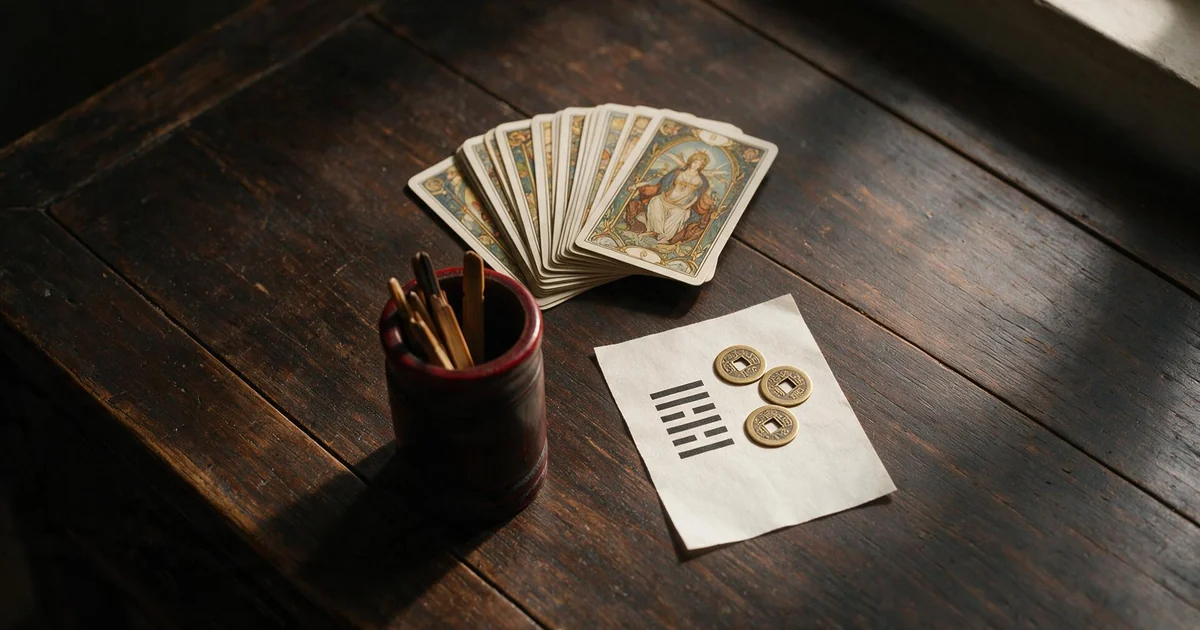
You have a question you cannot quite settle. You shuffle a tarot deck and turn over a card. Somewhere else, someone shakes a container of wooden sticks, or tosses three coins and writes down the result. If you know tarot, those gestures may feel surprisingly familiar.
In Chinese divination, fortune sticks and the I Ching offer two useful comparisons with tarot. Fortune sticks resemble the experience of drawing a single card; the I Ching opens up a different system of symbols and interpretation. “Eastern tarot” is a helpful starting point for that comparison, rather than the traditional name of either practice. Here, we are exploring Chinese traditions within a much larger and more varied East Asia.
How is drawing a fortune stick like drawing a tarot card?
The resemblance begins with the moment of selection. You bring a question, receive one result from a set, and work out how its meaning relates to your situation. With fortune sticks, the selected stick usually points you toward a poem rather than a picture.
From a wooden stick to a poem
The Chinese word qian means a lot or divination stick. Lingqian is often translated as “sacred lots” or “oracle lots.” You may also encounter kau cim, a Cantonese term for seeking a divination lot. Guanyin fortune lots are one well-known tradition associated with Guanyin, the bodhisattva of compassion.
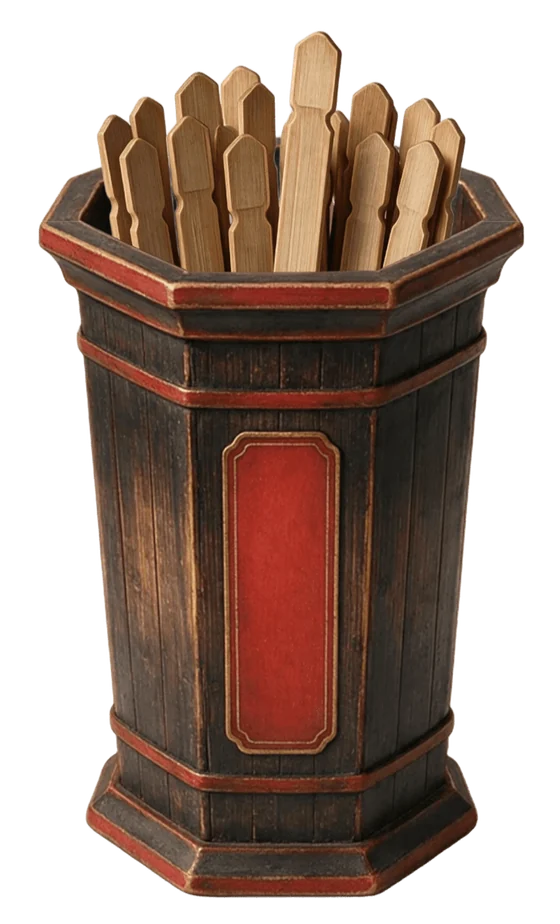
In a common form of the practice, a person presents a question, obtains a numbered stick, and finds the corresponding written lot. The text may include a poem, a traditional story, an auspiciousness label, and explanatory notes. A temple attendant or interpreter may help explain it.
The procedure varies. For example, Longshan Temple's own guide describes using crescent-shaped divination blocks to ask permission and confirm a lot. Follow the instructions of the temple you visit: one location's sequence and numbering should not be treated as universal.
The poem does the work of an image
A tarot illustration gives you something to notice: a turned-away figure, an offered cup, a path disappearing into the distance. A fortune poem gives you images in words. A boat, a returning traveler, a changing season, or the rising moon can provide a starting point for interpretation.
The example below is labeled Guanyin Lot 18, with a story title about Cao Guojiu, one of the Eight Immortals. Its English text describes the sun descending, the moon rising, and people following their different courses through recurring cycles.
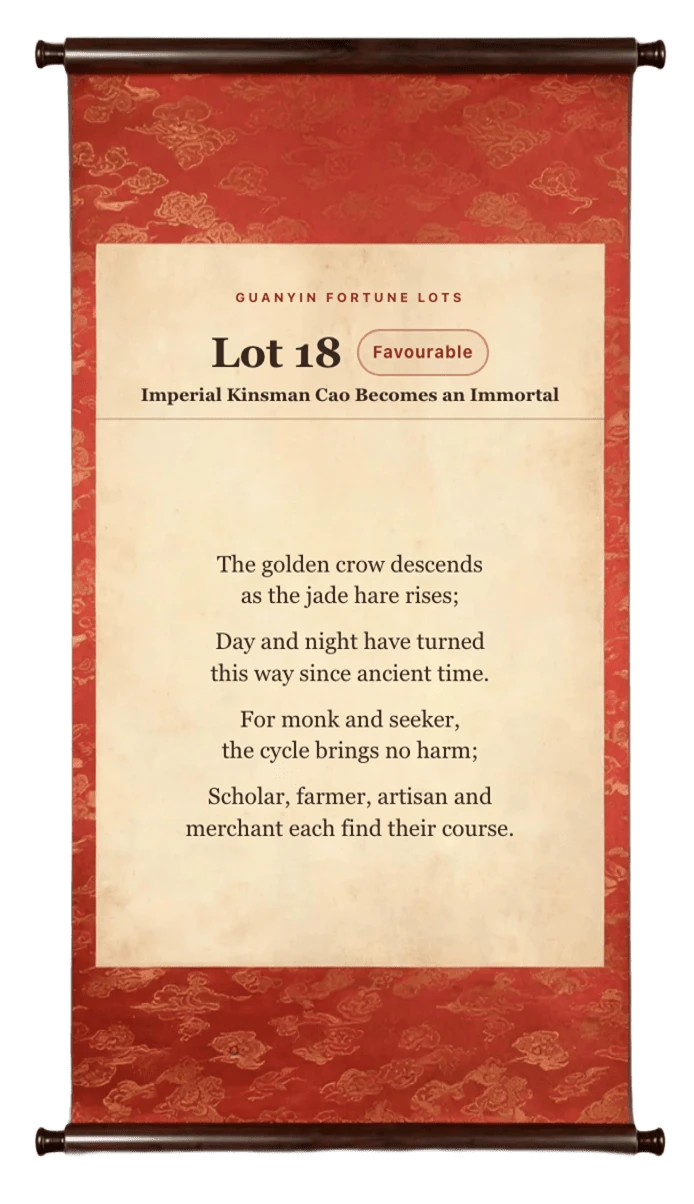
A reader might ask: Am I demanding that something happen immediately when it has its own rhythm? That is an interpretation of the poem's imagery. The favorable label by itself cannot explain what the person should understand or do.
This is where the comparison with a single-card reading becomes useful. The result offers material to interpret; it does not arrive with a personalized explanation already attached. At the same time, seeking a lot in a temple can be an act of prayer. That religious meaning deserves room alongside any comparison with tarot.
How can three coins become a reading?
Another Chinese tradition starts with lines. An unbroken line represents yang; a broken line represents yin. Stack six lines and you have a hexagram: a six-line figure with a place in a system of 64 possible arrangements.
These figures belong to the I Ching, also written Yijing and usually translated as the Book of Changes. It is a Chinese classic used in divination and studied for its reflections on situations, conduct, and change. The traditional text and its translations organize their interpretations around these figures.
Build the figure from the bottom up
Three-coin casting is one way to generate the lines. The illustration shows the two faces of a square-holed coin. A casting uses three coins, and ordinary coins work too.
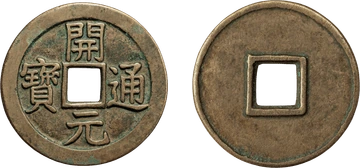
In a common convention, one face counts as 2 and the other as 3. Toss all three coins, add the values, and record the resulting line. Repeat six times, placing the first result at the bottom and each new line above it.
| Total for one toss | Line you record | Does it change? |
|---|---|---|
| 6 | Broken line: yin | Yes, into an unbroken line |
| 7 | Unbroken line: yang | No |
| 8 | Broken line: yin | No |
| 9 | Unbroken line: yang | Yes, into a broken line |
When there are changing lines, reversing those lines creates a second figure. You may see these called the primary hexagram and relating or changed hexagram. How the figures and changing-line texts are used depends on the method being followed. A changed figure should not automatically be treated as a guaranteed future event. This three-coin walkthrough shows the arithmetic and bottom-to-top order; the older yarrow-stalk method follows a different procedure.
Why some readings look like a detailed chart
For an introduction, it helps to distinguish two things: generating a hexagram and choosing a system for interpreting it.
Some readers primarily consult the hexagram statements, line texts, and commentaries. Another approach, often called Liu Yao or six-line divination, uses additional correspondences, including calendar information, the Five Phases, and relationships assigned to the lines. Seeing six lines does not mean every reader is using this same approach.
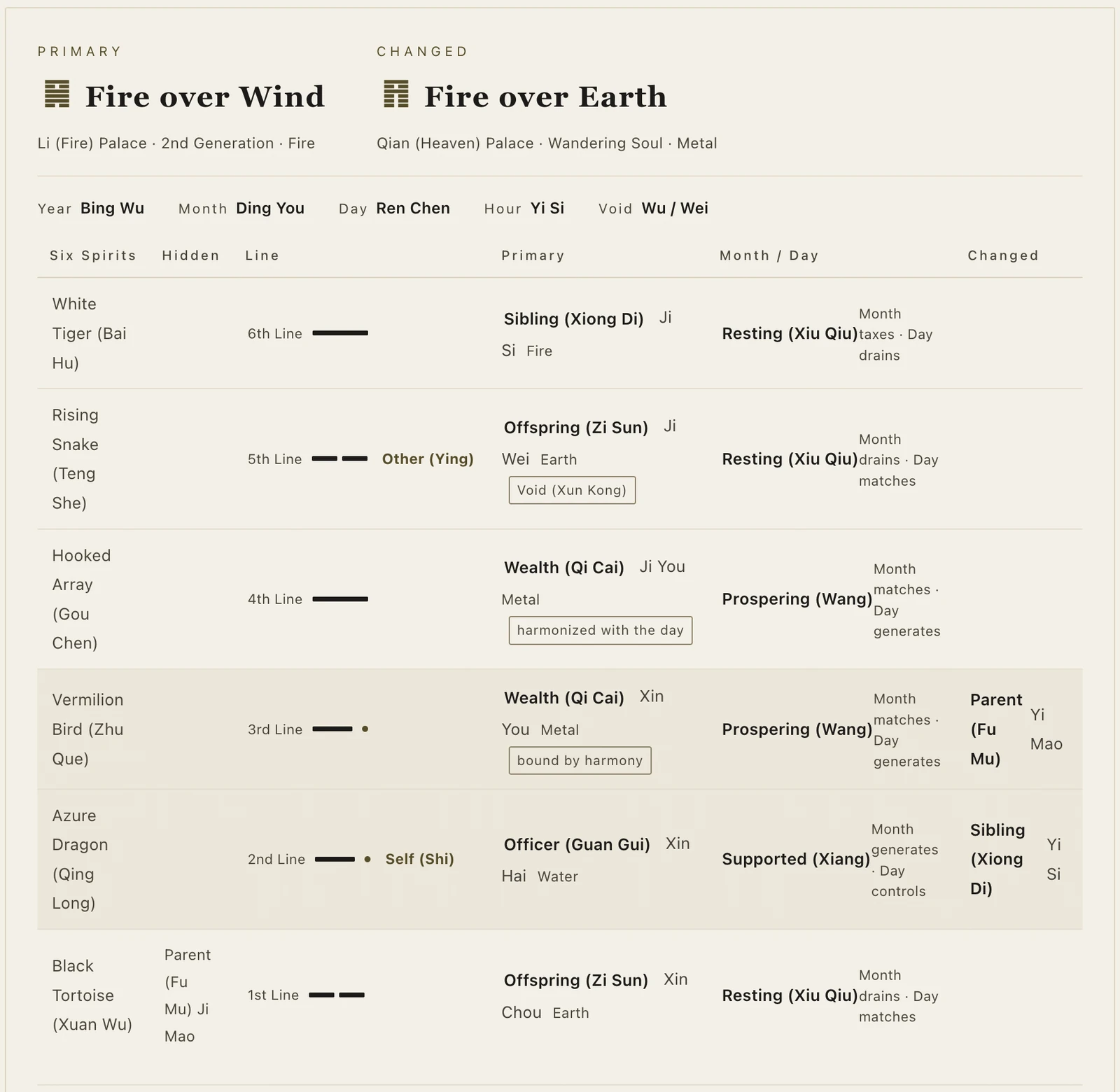
This chart illustrates that more detailed approach. The labels “Primary” and “Changed” identify the two figures; the other columns belong to its interpretive system. It is a separate example of what a chart can contain, not the reading used in the friendship example below. You do not need to learn all its columns to understand the basic comparison with tarot.
What do a card, a fortune poem, and a hexagram have in common?
All three can connect a question with a symbol that needs interpretation. The question gives the reading a context; the selected result gives the interpreter something specific to work with.
Consider an image of someone waiting. In a question about a delayed reunion, it might bring attention to patience. In a question about avoiding a difficult conversation, the same image might expose passivity. The surrounding text, positions, and rules matter too. A reading becomes weak when a symbol is made to mean anything the reader wants.
Tarot often makes this interpretive step visible through a spread. A card in the “obstacle” position is read differently from the same card in the “next step” position. Fortune lots connect an image or story with a question. I Ching traditions connect a situation with a particular figure and the texts or correspondences used to interpret it.
The family resemblance is real enough to be useful. It does not establish a shared historical origin, or turn every spiritual practice into the same activity. Our history of tarot follows tarot's own route from European playing cards to later divinatory uses.
What happens when all three meet the same question?
Take a familiar situation: a friend replies less often, and the conversation has become awkward. You are deciding whether to reach out again.
What can I do to improve communication with a friend I am drifting away from?
The following are deliberately selected teaching examples, not three reported random draws or a test of which system predicts better. They show how an interpretation can be connected to its source material.
Tarot: notice a pattern, then choose a response
Use three positions: my current stance / what I may be missing / a useful next step.
- Four of Cups, my current stance. A seated figure turns inward while an offered cup goes unnoticed. In this position, the image might prompt a check: have I become so focused on feeling rejected that I am overlooking small attempts at contact?
- Two of Swords, what I may be missing. The blindfold and crossed swords suggest a decision held at a distance. Here, that could mean avoiding a direct question and filling the gap with guesses.
- Temperance, a useful next step. The movement between two cups offers an image of adjustment and exchange. Applied to this question, it suggests a measured invitation that leaves room for the other person to respond.
One possible message follows: “I've missed talking with you. Would you like to catch up sometime this week?” The reading has moved from withdrawal, through avoidance, toward a manageable action. It has not established what the friend secretly thinks.
A fortune lot: pay attention to the rhythm you are expecting
Return to the Lot 18 illustration. Its sun-and-moon imagery describes a recurring rhythm; the different figures in the poem each have their own course.
Applied to this friendship, that can open a different question: Am I expecting our old pattern of daily contact to continue unchanged? Perhaps work, caregiving, or distance has changed the available time. Those are possibilities to ask about, not facts supplied by the poem.
The practical reflection could be to suggest a new rhythm: a call every other Sunday, for example. The reasoning comes from the poem's cycle imagery. Its favorable label does not promise that the friendship will recover.
An I Ching text: make your words concrete and your actions consistent
For this example, choose Hexagram 37, Jia Ren, often translated as “The Family.” Its upper trigram is wind and its lower trigram is fire. We are focusing on one passage in its Image commentary, rather than performing a full Liu Yao analysis.
The original passage connects the figure with words that have substance and conduct that remains consistent. A modern application to friendship might be: say what you mean, make a realistic invitation, and follow through if it is accepted.
That application is a present-day interpretation. The source text addresses the household and relationships within its historical setting; it does not mention messaging apps or prescribe this particular response. The useful connection is between dependable everyday conduct and the maintenance of a relationship.
These examples arrive at different questions: Am I withdrawing? Am I resisting a changed rhythm? Am I communicating and following through clearly? They need not agree to offer something worth considering.
How do these practices differ, and where should a beginner start?
“Eastern tarot” works best as an invitation to explore. The practices differ in what you handle, what you read, and the tradition surrounding the interpretation.
| Aspect | Tarot | Chinese fortune lots | I Ching divination |
|---|---|---|---|
| What you select or generate | One or more cards | A lot linked to a text | A six-line figure, sometimes with changing lines |
| What you encounter | Illustrated cards and spread positions | A poem, often with a story or explanatory notes | Hexagrams and the texts or correspondences of the chosen method |
| How a reading develops | Card meanings, images, positions, and relationships | The lot's imagery and wording in the context of the question | The figure and the interpretive rules being followed |
| Cultural setting | Varies from spiritual practice to reflective use | Often part of temple devotion and ritual | Classical study and several traditions of divination |
| A useful starting point | Learn a small spread and describe the images | Read a complete lot and learn its local context | Choose one clear casting and interpretation method |
If images and characters hold your attention, tarot may be the easiest starting point. If you enjoy poetry and stories, fortune lots may feel familiar. If a compact figure that opens into a longer text interests you, the I Ching is worth exploring.
When comparing interpretations, ask what each one is based on. Can the reader point to a detail in the card, a line in the poem, or a passage in the text? That is a better learning question than asking which tradition sounds more mysterious.
Questions you might still have about “Eastern tarot”
Is the I Ching a book or a divination method?
The I Ching is a classic text. Consulting it through divination is one way people engage with it. Coin casting generates a figure; the book, commentaries, and chosen interpretive tradition help a reader work with the result. The text can also be studied without casting anything.
Are fortune lots, I Ching readings, and BaZi the same thing?
They belong to different systems. Fortune lots and many I Ching consultations begin with a question and a newly obtained result. BaZi, commonly called the Four Pillars, constructs a chart from birth information. Calling all of them “Chinese astrology” hides that difference.
Do I need my birth date and time?
The basic three-coin method described here does not require birth information. Temple rituals may ask for personal details: Longshan Temple's guide includes stating a birthday when presenting a request. That is different from calculating a natal chart. Some divination systems also record the date and time of the consultation, so ask which time is being used and why.
Can I use tarot and the I Ching together?
You can study both, while keeping track of how each interpretation was reached. As a beginner, learn one method at a time and write down your first interpretation before trying another. Repeatedly switching systems until one gives a pleasing answer can make the original question harder to see.
Before your next reading, write three lines: what I know, what I am assuming, and what I can actually do. Then shape a question around the third line. If you want to begin with the cards you already recognize, our three-card tarot guide shows how to connect three positions into one reading.